In the heart of the ancient city of Patan Durbar Square, where time feels layered rather than linear, stands the resplendent Krishna Mandir—a monument that is as much a spiritual beacon as it is a masterpiece of stone artistry. As someone who walks these courtyards daily, observing both the rhythms of worship and the quiet erosion of centuries, Krishna Mandir is not merely a structure; it is a living narrative carved in stone.
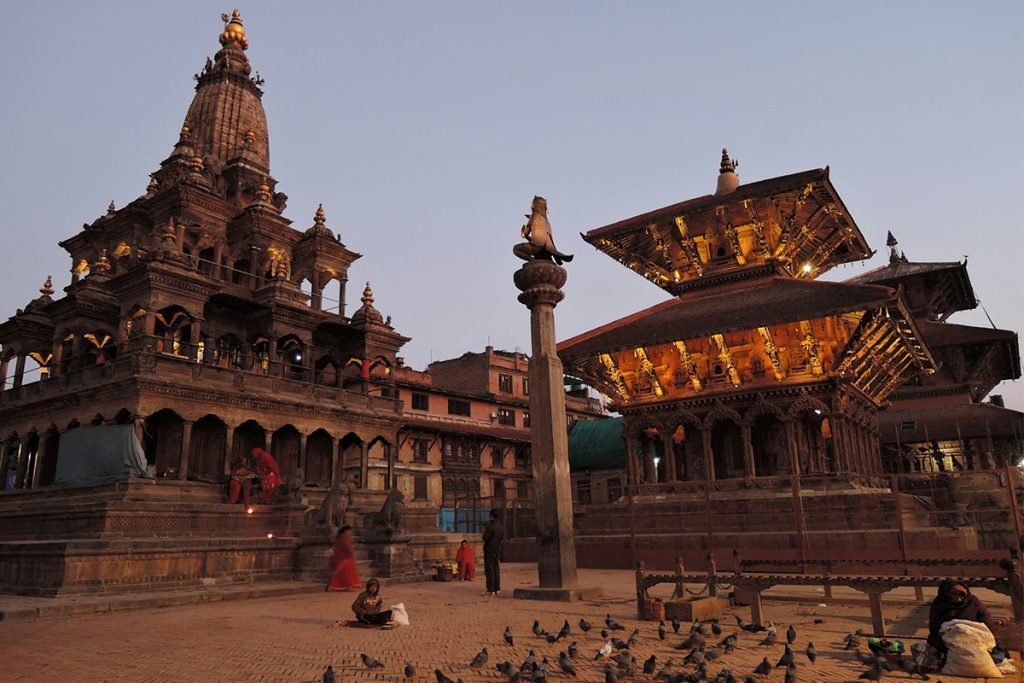
Built in the 17th century during the reign of King Siddhi Narasimha Malla, Krishna Mandir rises gracefully in the Shikhara style, a North Indian architectural form rarely seen in the Kathmandu Valley, where pagoda-style temples dominate. Its entire body is crafted from stone—a bold and unusual choice in a region historically reliant on timber and brick. This alone makes the temple a remarkable anomaly, but what truly sets it apart is the intricacy of its carvings. Each level of the temple tells a story, quite literally. Scenes from the Mahabharata and Ramayana unfold across its friezes, depicting divine battles, moral dilemmas, and cosmic duties with astonishing detail.
From a preservation standpoint, the temple is both a triumph and a challenge. Stone, while durable, is not immune to the forces of weathering, pollution, and seismic activity. The 2015 earthquake tested the resilience of many structures in the valley, and while Krishna Mandir stood firm, it reminded us of the urgent need for continuous conservation. Micro-cracks, biological growth, and the impact of increasing foot traffic all demand careful monitoring. Preservation here is not just about maintaining a building; it is about safeguarding a cultural identity.
But Krishna Mandir is not defined by architecture alone. It breathes through the myths and stories that surround it. One of the most enduring legends speaks of a divine dream. It is said that King Siddhi Narasimha Malla envisioned Lord Krishna and Radha appearing before him, standing atop a grand stone temple. Moved by the vision, the king commissioned the construction of Krishna Mandir exactly as he had seen it in his dream. Whether myth or metaphor, this story reflects a deeper truth about the temple—it is born from devotion as much as design.
Another tale often whispered among locals connects the temple to miraculous protection. During times of crisis—be it invasions, natural disasters, or epidemics—residents have long believed that the presence of Krishna Mandir shields the square. While such beliefs may not be empirically verifiable, they play a crucial role in how communities relate to heritage. These stories foster a sense of guardianship among locals, encouraging them to care for the temple not just as a relic, but as a protector.
The surrounding environment of Patan Durbar Square enhances the temple’s aura. The square itself is a dense constellation of palaces, courtyards, shrines, and statues, each contributing to a harmonious yet dynamic urban tapestry. Early mornings here are particularly evocative—soft sunlight touches the stone surfaces, pigeons scatter across the plaza, and the air carries the faint scent of incense. Vendors begin setting up their stalls, while devotees quietly circle the temple, offering prayers. By midday, the square transforms into a vibrant hub of activity, where tourists, artisans, and locals intersect.
From a creative perspective, Krishna Mandir is a storyteller’s dream. Its vertical ascent mirrors a spiritual journey, each tier bringing the observer closer to the divine. The temple’s symmetry offers a sense of order, while its carvings introduce complexity—much like life itself. Even the way light interacts with the stone changes throughout the day, casting shadows that animate the carvings, as if the stories are in motion.
Yet, there is an underlying tension that cannot be ignored. Modern pressures—urbanization, tourism, environmental degradation—pose real threats to the integrity of this heritage site. As a preservation officer, one must constantly balance accessibility with protection. Too many visitors can accelerate wear; too few can lead to neglect. Sustainable tourism practices, community engagement, and education are essential to ensure that Krishna Mandir remains both accessible and intact for future generations.
Ultimately, Krishna Mandir is more than a temple. It is a convergence point—of myth and history, art and devotion, past and present. To stand before it is to feel a quiet continuity, a reminder that while empires rise and fall, certain expressions of human spirit endure. In its stone walls, we find not just the stories of gods and kings, but also the enduring heartbeat of Lalitpur itself.